



Facial Rejuvenation
Conveniently located to serve the areas of Dallas, TX
Contents
Facial Rejuvenation Overview
[0:00] [Audio: Pleasant music] Dr. Steve White: Dividing the face into three regions for facial rejuvenation, considering the upper third, the middle third, and the lower third, is helpful as we begin to think about, what are the areas of concern? And what are the changes that we can make? Now, let’s think about the upper and middle third. We talk about the brow, as well as the upper eyelid and the lower eyelid. We may do all three, we may do one and not the other two, we may do two of three. It just depends upon what you may need, and what it is that you hope to achieve.
Brow Lift Options & Techniques
[0:40] So let’s talk about the brow lift. The endoscopic brow lift was popular for a while, but slowly became less popular because the results sometimes were not as impressive and didn’t last as long. The more definitive brow lift procedures involve a couple of different options.
[0:59] The bicoronal approach means from crown to crown, and so the incision runs across the top, typically within the hair-bearing area of the scalp. The other option is the hairline brow lift, and that’s a bit of a misnomer because the incision doesn’t run just across the hairline, but it also runs across the side in the hair-bearing area over on the side.
[1:20] So what determines which is the best option for the individual depends upon where their hairline is. So if we go above the top and remove some of the scalp and lift the tissues up, then in so doing, the hairline may come up a bit. However, if the hairline is really high, then we don’t wanna raise it too much higher. So in that case, we may choose to go along the hairline. And in so doing, that actually shortens the forehead. So in one case, we may lengthen it to some degree, to the other, we may shorten it to some degree. So it just kind of depends.
[1:55] Now there are some special techniques that I do, in order to optimize the scar along the hairline because that’s a very important concept. If we’re gonna place a scar there, we wanna make it as least noticeable as possible. Now there is an option that I use in some cases, and that is a modified hairline bicoronal brow lift that also involves lowering the hairline. And this is done rarely, but some patients have a very high hairline with a very large forehead, which creates an aged appearance. In those special cases, I will do the brow lift, but also go back to the back of the skull essentially and bring the whole scalp forward in order to lower the hairline at the same time.
[2:51] Some patients are a little scared about brow lifts. They think that they’re gonna look spooked or that their brows are gonna be way too high, and we find that that’s just not the approach that I take. My preference is a more natural appearance. In fact, a brow lift is one of my most favorite facial rejuvenation procedures. It has a very powerful effect and yet most patients, or a lot of patients, are unaware of what a brow lift really is.
[3:17] It’s not just lifting the brows, it opens the area between the brows and it also lifts the brows up and out. So it’s really more of a forehead plasty. It also has a Botox-type effect. The muscles here to relax, the muscle here to relax, as well as to remove a segment along the corrugators. So it creates very much a refreshed look in the whole upper portion of the face. In fact, the upper eyelids often look much better after a brow lift.
[4:19] It’s surprising how many patients have an asymmetry of the brows, one is a little lower than the other. And so as we remove the tissue and reposition it, I do it to a differential amount from side to side, dependent upon what their anatomy shows me as what needs to be done to get the best result for each person. The other nice thing about a brow lift is that it smooths the skin of the forehead, and frequently makes the fine lines much better.
Measuring the Forehead & Choosing the Right Approach
[5:27] What I like to do is use a very complicated measuring system for the forehead, and let me introduce that to you. It’s either a three-finger, a four-finger, or more. Now I’m kidding, but it actually works very well.
- Three-Finger Forehead: Often a somewhat lower hairline. If we remove a strip up above, then as we lift the brows, we also raise the hairline, which opens the forehead up a bit.
- Four-Finger Forehead: On the borderline, perhaps a little on the higher side. Frequently we’ll go from above, but sometimes along the hairline.
- Greater Than Four-Finger: May be a bit high. We may be more inclined to go along the hairline in the front and down the sides. The hairline stays where it is, but the brows get lifted up, so a longer forehead suddenly becomes not as big.
[7:05] What I’d like to do now is show you some examples of some of the brow lift surgery, and different combinations of procedures so that you can understand the power of a brow lift.
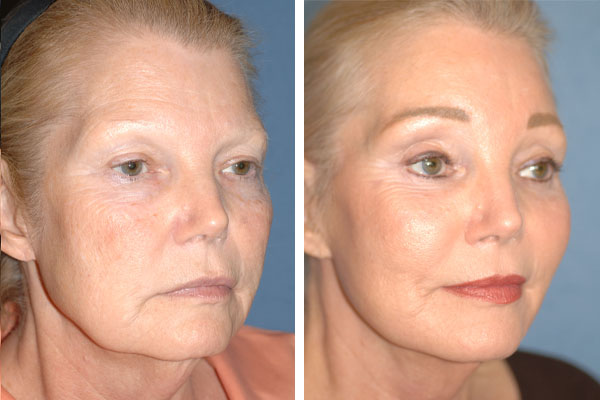
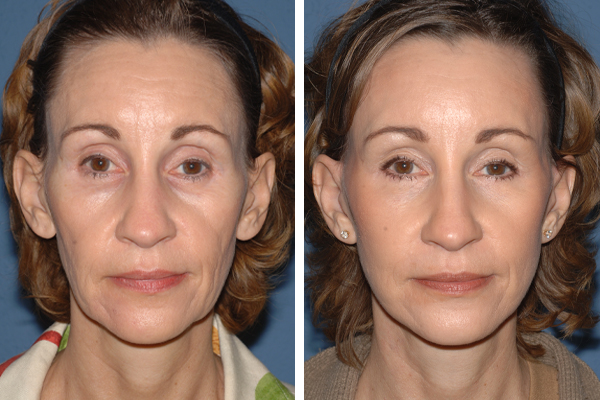
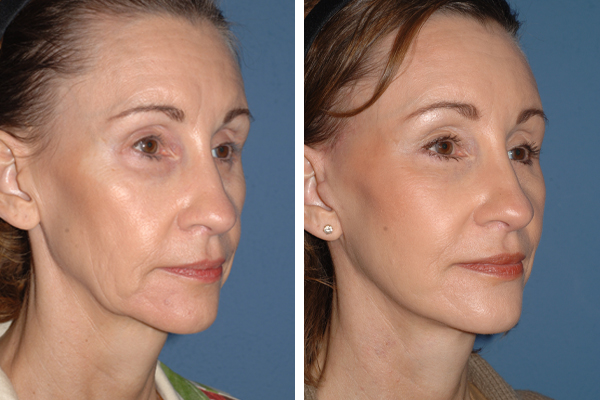
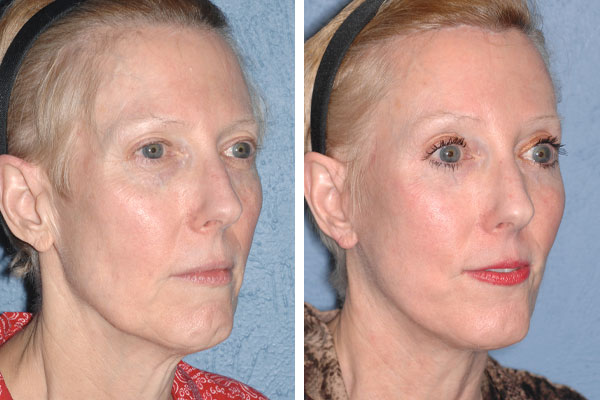
[7:17] This patient is an example of a brow lift alone, without any other facial rejuvenation procedure. If you notice the difference in the forehead, the area between the brows, the position of the brows, but also the upper eyelids, it creates a very rejuvenating look.
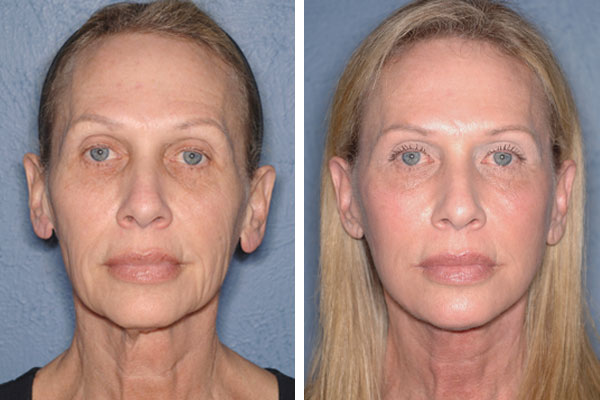
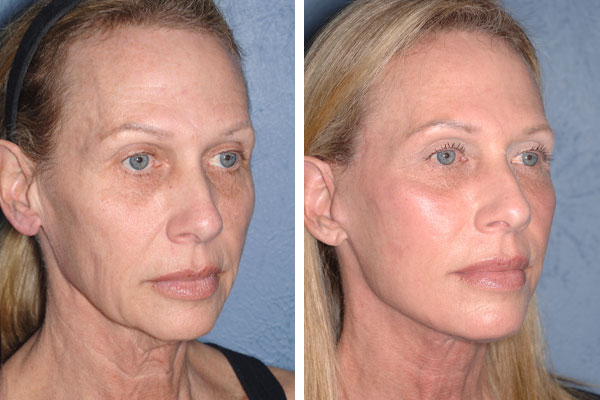
[7:35] This patient demonstrates the brow lift, as well as a face and neck lift. Now notice, there’s no eyelid surgery. However, the upper eyes look much improved. And the lower eyelids look improved as well because the face lift does provide some improvement in the lower eyelids.
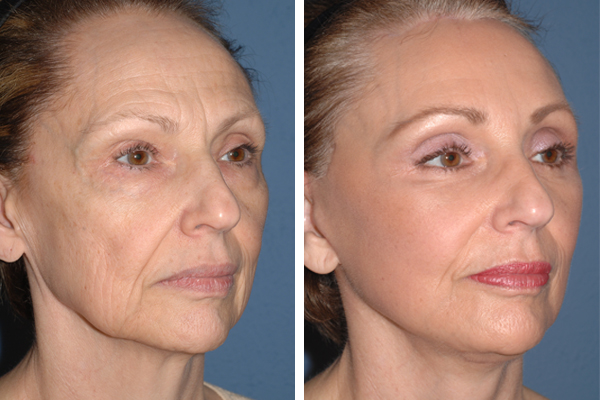
[7:55] This patient is a great example of a full facial rejuvenation with a brow lift, the upper and lower eyelid, as well as the face and neck lift. I think you can see, it’s a very natural and refreshed look.
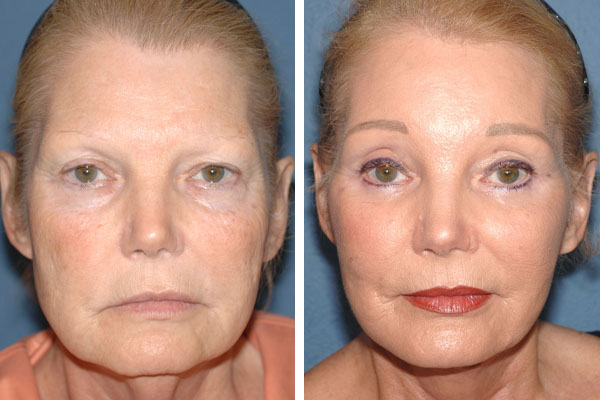
[8:55] This patient demonstrates a modified hairline bicoronal brow lift with lowering of her hairline, as well as her lower eyelid blepharoplasty, and then the face and neck lift. Now in her case, I took out three centimeters of tissue and lowered her hairline by three centimeters. By lowering her hairline, I think it really made a dramatic change in her overall appearance and she was very, very pleased with the outcome.
Eyelid Rejuvenation (Blepharoplasty)
[9:48] So let’s talk about the different types of eyelid rejuvenation or blepharoplasties. The upper blepharoplasty tends to be pretty straightforward. It involves removing some of the skin, as well as some of the protuberant fat. And this deepens the crease, and then we sew this up.
[11:45] Regarding the lower eyelid, there are more options for lower eyelid surgery. The two basic concepts are either going from inside the eye, which is called transconjunctival, or to go from the external approach, which is considered a skin or a skin-muscle flap, and that’s the preferred choice for me.
[12:11] I like to go from inside the eye if we are fixing an orbital fracture. But if you have aging around the eyelids, then most commonly it’s not just the fat, but it’s also some of the skin. If you go with a transconjunctival approach from the inside, you remove the fat from the inside, but then you have to go to the outside and also remove some of the skin. To me, what I’m trying to do is avoid weakening of that lower eyelid. Intuitively, if I work on the inside and also work on the outside, I think that may lead to additional risk of weakening of that eyelid and possibly scarring.
[12:57] So my preferred approach is called a skin-muscle approach. This involves making a very small incision right directly underneath the lashes, which is almost imperceptible once this heals, and then to come out here within one of the natural creases at the corner of the eyes called the crow’s feet.
[13:31] As we consider the external approach, I make a very small incision, I go underneath the skin, I leave a little bit of muscle attached along the lid margin. After surgery, the muscles are somewhat weak, the nerves to the muscles may be involved, and it may be somewhat difficult to have complete eye closure. The one thing you don’t want is a dry eye. You don’t want a corneal ulcer and need a corneal transplant because you had your eyes done. So for this reason, I take special precautions to ensure that we keep the eyes very well lubricated and that we’re very conservative with the eyelid surgery.
The Extended Lower Blepharoplasty (“Turbo Bleph”)
[14:39] I go through the skin, above the muscle, a little bit down below, and then go under the muscle all the way down to the orbital malar ligament or the edge of the orbit. At that point, I do a relaxing incision all the way across, and that frees up the cheek, which is descended to some degree with time, and allows me to lift that up at the same time.
[15:26] One has to consider the effect of gravity. Some patients are predisposed to the cheek sliding down with time. Those are patients with morphologically prone eyes. Some people may say that’s a polar bear syndrome, or a negative vector. So what I like to do is to preemptively treat all patients by providing a little bit of support of the lower eyelid, a little tightening of the lower eyelid.
[16:16] I call that an extended lower blepharoplasty. Some people may call that a turbo blepharoplasty, but I think it’s a wonderful change and it allows for a much more natural interface. If you only treat that lower eyelid skin and puffiness without addressing this area here, then I think you’ve lost an opportunity to treat that aging process of the area just below the eyelid.
[16:42] Now there are a number of patients who have seen dermatologists and perhaps other plastic surgeons, that talk about filling this hollowness here with fillers. And I’m not in favor of that. I think you have to be very, very careful because any type of filler that is placed in that area possibly could go back to the back of the eye. There’s only one blood vessel that goes to your eye, and you don’t wanna go blind. That can also lead to some unpredictable swelling, and sometimes it can create quite a bit of puffiness above that can last for an extended period of time.
[18:08] We should be somewhat conservative with lower eyelid surgery as well as upper. You don’t want to take out too much; you can always take out more. We wanna be careful regarding dry eyes. Many patients have dry eyes ahead of time, and they’re unaware of it. If you do a Schirmer’s test, you’ll determine that they actually have dry eyes. Some patients who have dry eyes can be treated with what’s called a punctal plug, which is a little silicone plug that just backs up the tears in the eyes, and they tend to work really well.
[20:25] I’d like to talk a little bit about the transconjunctival lower eyelid. I had a gentleman come to see me once and he was an interior designer and he said, “Dr. White, all I want are my lower eyelids done, but I just want the inside done, just take out the excess fat.” I told him we really needed to do it my way to get the best result. After surgery, he was so excited, he told people, “Look here, see what I’ve had done… see, you can’t even see the scar.” So it can heal well if it’s done appropriately.
Preparing for Surgery & Recovery
[23:54] For eyelid rejuvenation preoperatively, we typically see you several weeks in advance. We go over informed consent, give you an informational booklet, take pictures, and check out your medical history, labs, and EKG.
[24:16] We also want you to see the eye doctor. Don’t blow off seeing the eye doctor. This is really important because if there’s anything going on with the eyes, I wanna know about it before we operate, not after.
[24:44] The other key concern is you don’t want bleeding around the eyes, so be absolutely certain that you stop your Aspirin, Motrin, Advil, Aleve, any of those non-steroidal or anti-inflammatory type medicines for two weeks before and two weeks after surgery.
[25:34] The OR day is pretty straightforward. You go to the operating room, you have surgery, and typically you’ll go home afterwards. Early on, we expect you to have some swelling and some bruising. It helps quite a bit to have some cool compresses, at least for the first several days—like frozen peas or the Swiss eye mask. But you don’t wanna be sitting up with something heavy on your lower lids that’s pulling down. It’s helpful when you have the gel packs on that you’re lying flat.
[26:23] The sutures are typically removed in one week. After that, we begin some massaging exercises of the scars, stretching exercises of the lower eyelid, and frequently some squinting exercises to work on strengthening the muscles.
[27:59] When can I go back to work? Three weeks is certainly adequate, one week might be fine, might be a week and a half, two weeks, it just kind of depends. You can work from home, you can wear sunglasses, no one would know. However, with glasses off, it could be 10 days, a week, maybe a couple, it really depends on each person.
Reviewing Patient Results
[31:09] Now let’s take a look at some more results for upper facial rejuvenation.
[31:51] This is an example of a patient who just had a bicoronal brow lift. She has a lot of brow ptosis. After the brow lift, it rejuvenates the entire forehead. Her brows are not too high, but it’s made a very nice difference in her upper lids.
[33:44] This patient I think is an excellent example of the power of a brow lift. In her case, I did her brow, as well as her face and neck, but she’s had no eyelid surgery. Look at the powerful change in her upper eyelids. The crowding and angry and tired look that was here has really been refreshed.
[35:31] This gentleman may have benefited from a brow, upper and lower blepharoplasty, but as guys go, sometimes he didn’t want to do too much. He said, “Let’s just start with the brow in the lower.” Notice the quality of the forehead skin. Before surgery, he’s squinting. You can see those corrugator supercilii muscles. After surgery, after I remove a segment of those muscles, he still has forehead function, but it’s really a Botox-type effect.
[38:06] This patient is a gentleman who just had his upper eyelids done. Even though his brows are still a bit low, I think it really cleaned up his upper eyelids.
[39:04] This patient is a great example of a full facial rejuvenation. She had a bicoronal brow lift, upper and lower eyelid surgery, as well as a face and neck. I added a small chin implant as well. Patients often comment that now they can wear eyeliner and mascara and it really makes a nice difference. I think she’s a great example of a full facial rejuvenation, brow, upper and lower lids, as well as the face and neck.